Historical eclipses
Eight solar eclipses that mattered to science, to the historical record or to the craft of observing, in date order. The data sits in the app itself; Open in the app brings up the map and the circumstances on the ground.
For eclipses more than five hundred years ago, the computed path and times depend on ΔT, the difference between the rotation of the Earth and a uniform clock. For those centuries ΔT is an estimate, so the times and places here are approximate. Nor is it always certain which eclipse a historical source refers to.
15 June 763 BCE · the Assyrian eclipse
An Assyrian list of year names records, in the year of Bur-Sagale, that the sun was eclipsed in the month of Simanu; the same entry mentions a revolt in the city of Ashur. That list runs on into years that can be dated independently, so this eclipse fixes the chronology of the ancient Near East to a single day. Every Assyrian and Babylonian date before it hangs on that one anchor. The record names no place. The computed path ran across northern Mesopotamia, over Guzana, the province Bur-Sagale governed; Nineveh and Ashur lay just outside it. It does assume that the scribe meant a total eclipse and not a partial one.

Open in the app · Wikipedia: Assyrian eclipse
28 May 585 BCE · the eclipse of Thales
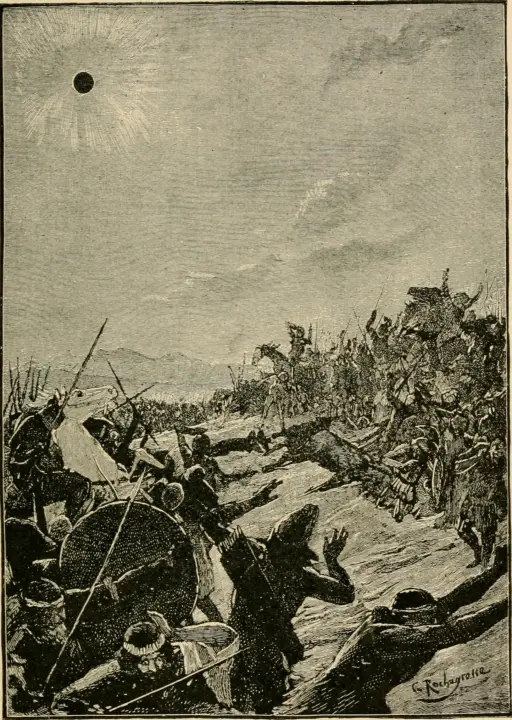
Herodotus writes that a battle between the Medes and the Lydians broke off when day turned into night, and that Thales of Miletus had predicted the eclipse. Frightened by the darkness, both sides stopped fighting and made peace after five years of war. The rulers of Cilicia and Babylon brokered it, and a marriage between the two royal houses sealed it. It is the only solar eclipse said to have ended a war. Herodotus names no battlefield; the Halys, later the border, is a guess. The computed path crossed Anatolia south of that river, over Cappadocia, where the globe below stands at Tyana. That makes the classical date plausible, though other years have been proposed. Whether Thales really predicted it, and how, is something historians still disagree about.

Open in the app · Wikipedia: Eclipse of Thales
22 December 968 · an early description of the corona
Leo the Deacon, an eyewitness in Constantinople, described how the sun disappeared, how stars came out in the middle of the day, and how a narrow, dim glow stood around the darkened disc. In that glow the solar corona can be recognised; it is one of the earliest descriptions of it. Leo also records the fear in the city, because a darkening sun was read as an omen. The corona can only be seen by eye during totality, so he must have been standing inside the path.

Open in the app · Wikipedia: Corona
3 May 1715 · Halley’s eclipse
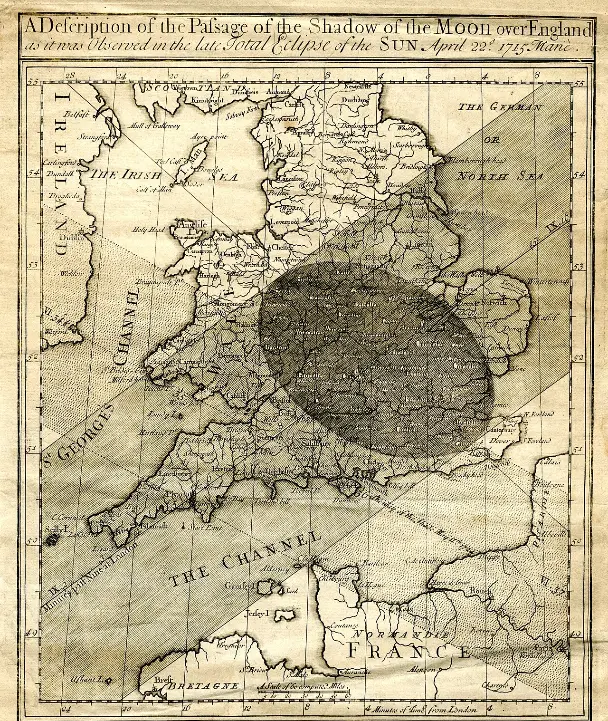
Edmond Halley published a map of the expected path across England beforehand and asked observers to send in their timings, so that he could check his prediction against them. It was the first time an eclipse was treated as a joint measuring project, and the timings he received let him improve the position of the Moon in the tables of his day. His path was off by a few tens of kilometres, and he reported that as openly as the part he got right. His map also brought the idea of a path of totality to a wide public, and it counts as one of the first thematic maps.

Open in the app · Wikipedia: Solar eclipse of 3 May 1715
15 May 1836 · Baily’s beads
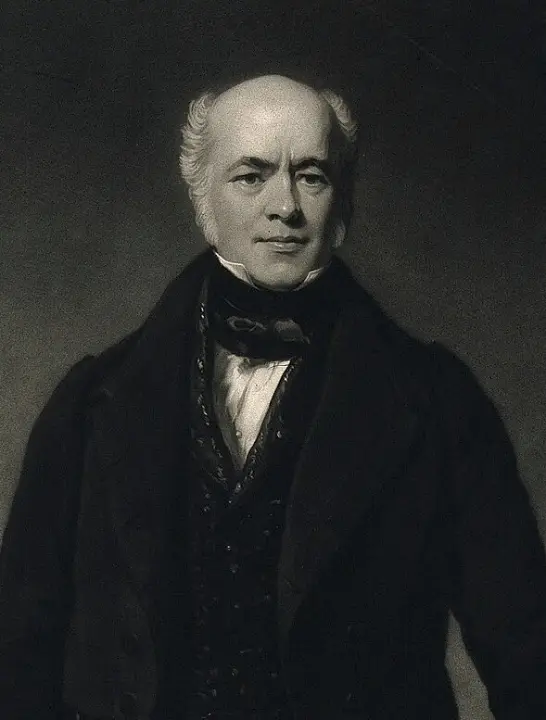
Francis Baily watched this annular eclipse from Scotland and described how the last thread of light along the Moon's edge breaks up into separate beads, because it shines through the valleys between the mountains on the Moon. The phenomenon had been noticed before, by Halley among others, but it was Baily's account that stuck, and it has carried his name ever since. It is still the sign that totality is about to begin or has just ended. His report also set off a wave of expeditions to later eclipses, which is how watching an eclipse became real fieldwork.

Open in the app · Wikipedia: Baily’s beads
28 July 1851 · the first photograph of an eclipse
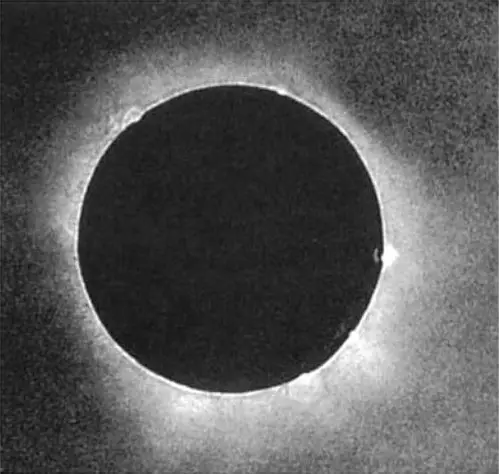
At Königsberg Observatory, Johann Julius Friedrich Berkowski made the first known photograph of a total solar eclipse: a daguerreotype exposed for about a minute and a half through a small telescope, with the corona around the black disc. From then on, photography at an eclipse was a measuring instrument and no longer only a record. The plate also helped settle a long-running argument, because some had dismissed the corona as an optical illusion or an effect of the atmosphere. What a photograph holds can be measured again later, by someone who was not there.

Open in the app · Wikipedia: Solar eclipse of 28 July 1851
18 August 1868 · helium
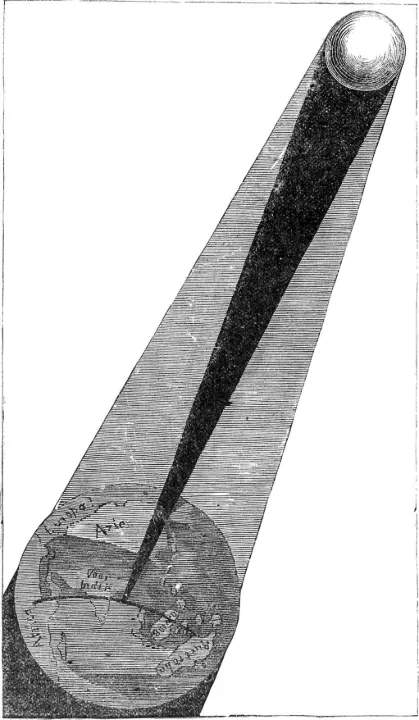
During this eclipse, observers in India and Siam saw a yellow line in the spectrum of the sun's edge that matched no known element. It was soon put down to a new element, helium, which was not found on Earth until nearly thirty years later. Helium is therefore the first element discovered beyond the Earth before anyone found it on the Earth itself. At the same eclipse, Jules Janssen found a way to observe prominences on any clear day, without waiting for an eclipse, and since then solar physics no longer depends on the eclipse calendar.

Open in the app · Wikipedia: Solar eclipse of 18 August 1868
29 May 1919 · a test of Einstein’s relativity
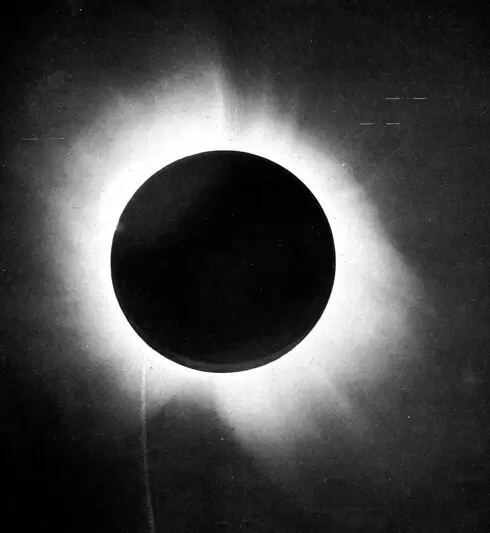
Two British expeditions, to Príncipe off the coast of Africa and to Sobral in Brazil, photographed the star field around the eclipsed sun to see whether the sun's gravity bends starlight. The measured deflection of nearly two arcseconds fitted general relativity rather than Newton, and the announcement in November 1919 made Einstein famous the world over. Not all the plates were usable: the main instrument at Sobral was out of focus, and its result was set aside. That choice has been argued over ever since. Later measurements, using radio sources instead of stars, have confirmed the deflection far more precisely.
